n = 25: Optimal Unit Disk Covering
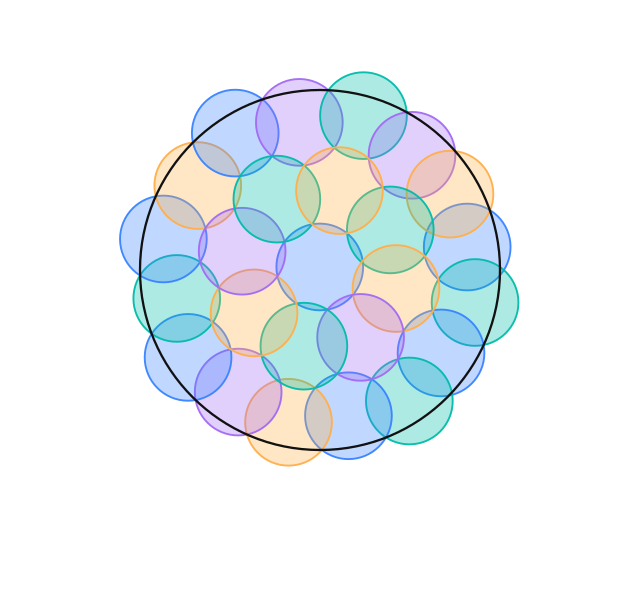
Test records
| Model | Score (higher is better) |
|---|---|
| gpt-6.1 sol/max Test date: (UTC) | 230 |
| gpt-6 astra/max Test date: (UTC) | 0 (Incomplete) |
Best recorded run
A run of an algorithm developed and optimized through human–AI collaboration, on specified hardware. Timing covers execution and required verification; prior development effort is recorded separately. Uses the same scoring formula as the model tests; higher is better.
| Algorithm | Score (higher is better) |
|---|---|
| DGC v62-G · MinPoly v15 | 883 |
The global optimality proof was accepted by local project review; this run’s score and fingerprint match do not themselves verify a proof.
Scoring details
Test prompt
Optimal Covering of the Unit Disk with 25 Disks
Let
$$
D=\{x\in\mathbb R^2:\|x\|_2\le1\},\qquad
R_D(C)=\max_{x\in D}\min_{1\le i\le25}\|x-c_i\|_2,
$$
where $C=(c_1,\ldots,c_{25})\in(\mathbb R^2)^{25}$, and define
$$
r_D(25)=\inf_{C\in(\mathbb R^2)^{25}}R_D(C).
$$

The covering disks are closed. They may overlap and extend beyond $D$; their centers are not initially restricted to lie in $D$.

Determine $r_D(25)$ and satisfy all of the following requirements:

1. **Minimal polynomial and root isolation:** Explicitly list every coefficient of the normalized integer representation $P(t)\in\mathbb Z[t]$ of the minimal polynomial of the optimal radius $r_D(25)$ over $\mathbb Q$. Require $P$ to be nonconstant and primitive, with positive leading coefficient, and prove that it is irreducible in $\mathbb Q[t]$. Give specific rational numbers $0\le a<b$, prove $P(a)P(b)\ne0$, and prove that $P$ has exactly one real root $\alpha$ in $(a,b)$. Use the configuration and proofs below to establish $r_D(25)=\alpha$.
2. **Explicit configuration:** Give a definite ordered tuple of centers $C_*=(c_1^*,\ldots,c_{25}^*)$, specified exactly by radicals, polynomials and rational isolating intervals, or other explicitly supplied finite algebraic data whose uniqueness is proved. Uniqueness here means that the submitted data uniquely specify these center coordinates; it does not require a proof that the optimal configuration is unique.
3. **Coverage:** Rigorously prove
   $$
   \forall x\in D,\quad\exists i\in\{1,\ldots,25\},\quad
   \|x-c_i^*\|_2\le\alpha.
   $$
   If continuous coverage is reduced to a finite set of checks, prove that the reduction is sufficient and rigorously complete every required check.
4. **Global optimality:** Rigorously prove
   $$
   \forall C\in(\mathbb R^2)^{25},\quad R_D(C)\ge\alpha,
   $$
   and hence $R_D(C_*)=r_D(25)=\alpha$. Do not restrict symmetry, contact relations or combinatorial structure without proof. Every normalization, classification, enumeration or pruning step must be proved not to omit a potentially better configuration. Handle coincident centers, redundant disks and other relevant degeneracies.
5. **Computer-assisted proof:** If the proof relies on computation, deliver the complete code actually used, inputs, certificates, necessary environment information and actual verification results. Explain why those results imply the mathematical statements above.

**Final submission:** Explicitly list every coefficient of $P(t)$ and the rational root-isolating interval $(a,b)$, together with the configuration, complete proof and necessary verification materials. Submit the minimal polynomial of the optimal radius itself. A polynomial for its square or another auxiliary quantity, or an elimination polynomial without a proof of irreducibility, does not satisfy the requirement.

Any rigorous method is allowed. Merely proving existence or algebraicity, or supplying unfinished enumeration, a solution algorithm or a numerical candidate, does not count as completion. Successful numerical optimization, a program printing “passed”, or floating-point results without rigorous error control cannot replace a proof. Checking only finitely many sample points, the boundary, or a numerical image cannot replace a proof that the entire closed unit disk is covered.
Optimal Covering of the Unit Disk with 25 Disks
Let
$$
D=\{x\in\mathbb R^2:\|x\|_2\le1\},\qquad
R_D(C)=\max_{x\in D}\min_{1\le i\le25}\|x-c_i\|_2,
$$
where $C=(c_1,\ldots,c_{25})\in(\mathbb R^2)^{25}$, and define
$$
r_D(25)=\inf_{C\in(\mathbb R^2)^{25}}R_D(C).
$$
The covering disks are closed. They may overlap and extend beyond $D$; their centers are not initially restricted to lie in $D$.
Determine $r_D(25)$ and satisfy all of the following requirements:
1. **Minimal polynomial and root isolation:** Explicitly list every coefficient of the normalized integer representation $P(t)\in\mathbb Z[t]$ of the minimal polynomial of the optimal radius $r_D(25)$ over $\mathbb Q$. Require $P$ to be nonconstant and primitive, with positive leading coefficient, and prove that it is irreducible in $\mathbb Q[t]$. Give specific rational numbers $0\le a<b$, prove $P(a)P(b)\ne0$, and prove that $P$ has exactly one real root $\alpha$ in $(a,b)$. Use the configuration and proofs below to establish $r_D(25)=\alpha$.
2. **Explicit configuration:** Give a definite ordered tuple of centers $C_*=(c_1^*,\ldots,c_{25}^*)$, specified exactly by radicals, polynomials and rational isolating intervals, or other explicitly supplied finite algebraic data whose uniqueness is proved. Uniqueness here means that the submitted data uniquely specify these center coordinates; it does not require a proof that the optimal configuration is unique.
3. **Coverage:** Rigorously prove
$$
\forall x\in D,\quad\exists i\in\{1,\ldots,25\},\quad
\|x-c_i^*\|_2\le\alpha.
$$
If continuous coverage is reduced to a finite set of checks, prove that the reduction is sufficient and rigorously complete every required check.
4. **Global optimality:** Rigorously prove
$$
\forall C\in(\mathbb R^2)^{25},\quad R_D(C)\ge\alpha,
$$
and hence $R_D(C_*)=r_D(25)=\alpha$. Do not restrict symmetry, contact relations or combinatorial structure without proof. Every normalization, classification, enumeration or pruning step must be proved not to omit a potentially better configuration. Handle coincident centers, redundant disks and other relevant degeneracies.
5. **Computer-assisted proof:** If the proof relies on computation, deliver the complete code actually used, inputs, certificates, necessary environment information and actual verification results. Explain why those results imply the mathematical statements above.
**Final submission:** Explicitly list every coefficient of $P(t)$ and the rational root-isolating interval $(a,b)$, together with the configuration, complete proof and necessary verification materials. Submit the minimal polynomial of the optimal radius itself. A polynomial for its square or another auxiliary quantity, or an elimination polynomial without a proof of irreducibility, does not satisfy the requirement.
Any rigorous method is allowed. Merely proving existence or algebraicity, or supplying unfinished enumeration, a solution algorithm or a numerical candidate, does not count as completion. Successful numerical optimization, a program printing “passed”, or floating-point results without rigorous error control cannot replace a proof. Checking only finitely many sample points, the boundary, or a numerical image cannot replace a proof that the entire closed unit disk is covered.
Reference answer SHA256
2cf89430e0f746fabd1f84298f3449cb9f755a8c3d41a198b2881dd042d06e12
The n=25 global optimality proof was accepted by local project mathematical review on 2026-09-26. This fingerprint compares optimal-radius answer data; it does not verify a submitter’s coverage or global lower-bound proof.